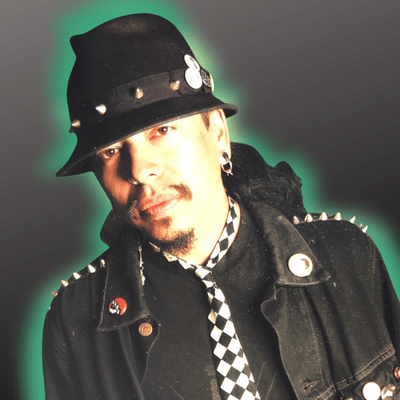
Stevie Punxxxter
Stevie Punxxxter started guitar strumming at age 15 when he convinced his mom to buy him a Les Paul copy and a Peavey amp at a garage sale in the neighborhood. Already, Stevie has served in the DIY Punk Rock scene in Southern California for four decades and continues to do so. He has recorded electric guitar for multiple successful bands in the Long Beach Punk & Hardcore scene, including Beat To Death, Kontraklasse, Kingkillers, and Raven's Moreland and has built a home studio where he writes his own beats and records his own tracks for all the world to experience in a good time! He is currently working on the song releases of his first solo project and brand "Stevie Punxxxter"
For Stevie Punxxxter, music stopped being background noise before he could even spell the word. Sitting shotgun in his Pop’s custom lowriders, rolling through the mural-soaked, graffiti-scarred streets of East L.A., he felt sound and sight fuse into something bigger. “Oldies,” War, Carlos Santana—those records weren’t just tunes, they were living proof that music could capture entire cultures and fuel social movements. In that moving gallery of chrome, concrete, and color, Stevie understood that visuals and sound were a single language, and that language had just claimed him for life.
When home fractured at age 11, that language became his lifeline. As a latchkey kid navigating a broken home, skateboarding and bikes kept his body busy, but the real chaos was internal. Punk rock records, battered album covers, and the electric guitar had eventually become his refuge. In those grooves and distorted riffs, he didn’t just find distraction—he found validation. The rage, confusion, and raw emotion he couldn’t articulate were all there, screaming back at him in a way that said, “You’re not crazy, you’re not alone.”
His album cover heroes were never just icons in his mind—they were blueprints. Lowrider oldies taught him the power of emotional truth. Ace Frehley’s cosmic showmanship, Tony Iommi’s heavy soul, and Angus Young’s wild abandon showed him what it meant to let a guitar become an extension of your being. English punk bands like Discharge, G.B.H., Varukers, and Chaos U.K., along with American punk bands like the Plasmatics with Wendy O. Williams and Ritchie Stotts, blew the doors off what performance could look like—Mohawk, tutu, Flying-V, and all—raising the bar for both sound and presence. And then there was Cheech & Chong, the East L.A. legends who proved that you could move from music into full-blown cultural impact while still speaking directly to the world you came from. They made it clear: you didn’t have to leave your roots to become larger-than-life.
The real turning point hit in his teenage years, when the DIY ethos of punk and the house-party spark of early West Coast hip-hop collided. In that moment, Stevie realized he didn’t want to be a spectator in the crowd—he wanted to be the one plugging in the amp. The underage LA scene was building its own stages in backyards and community halls, and the message was simple: show up, do your version. At 15, he picked up his first electric guitar and never put it down, stepping fully into a life where lowrider and chopper culture flowed straight into street dance, neighborhood punk, and a new identity as an active creator.
As time moved into the late ’80s and ’90s, underground warehouse parties pulled him deeper into sound. These spaces—raw, inclusive, and untouched by gang violence or corporate gloss—showed him how strangers could become a temporary tribe through amplified dance music. The pulsing NRG, emerging electronic beats, and pioneers like Kraftwerk expanded his world. Punk and electronic music fused into a personal language that felt like home. But after decades of living the Long Beach punk band lifestyle and becoming a father, another truth surfaced: he needed to grow. Facing the fallout of a failed relationship and a deeper need for personal development, he stepped away from making music for almost twenty years.
Now, Stevie Punxxxter has come full circle—with sharper purpose and scarred optimism. Over the past few years, his first love has returned in full force. From his DIY home studio in newly relocated Tonopah, Arizona, he’s forging electropunk, G-punk, electrofunk, chiptune influenced, and cinematic textures into something that doesn’t sit in a lane—it creates its own by collision. Punk meets electro, street meets sacred, dance-floor energy meets survival themes. He’s not interested in plastic positivity or escapist hype; his “survival music” moves through grit to reach hope that’s earned. His mission is clear: to serve fellow “Soul Rebels,” to help artists and communities leverage their strengths as a force for goodness in these apocalyptical times. When people press play on Stevie Punxxxter, he wants them to feel both seen and activated—invited to transform their inner world first, then their environment, shifting the energy of the universe toward something more alive, more functional, and fiercely human.